
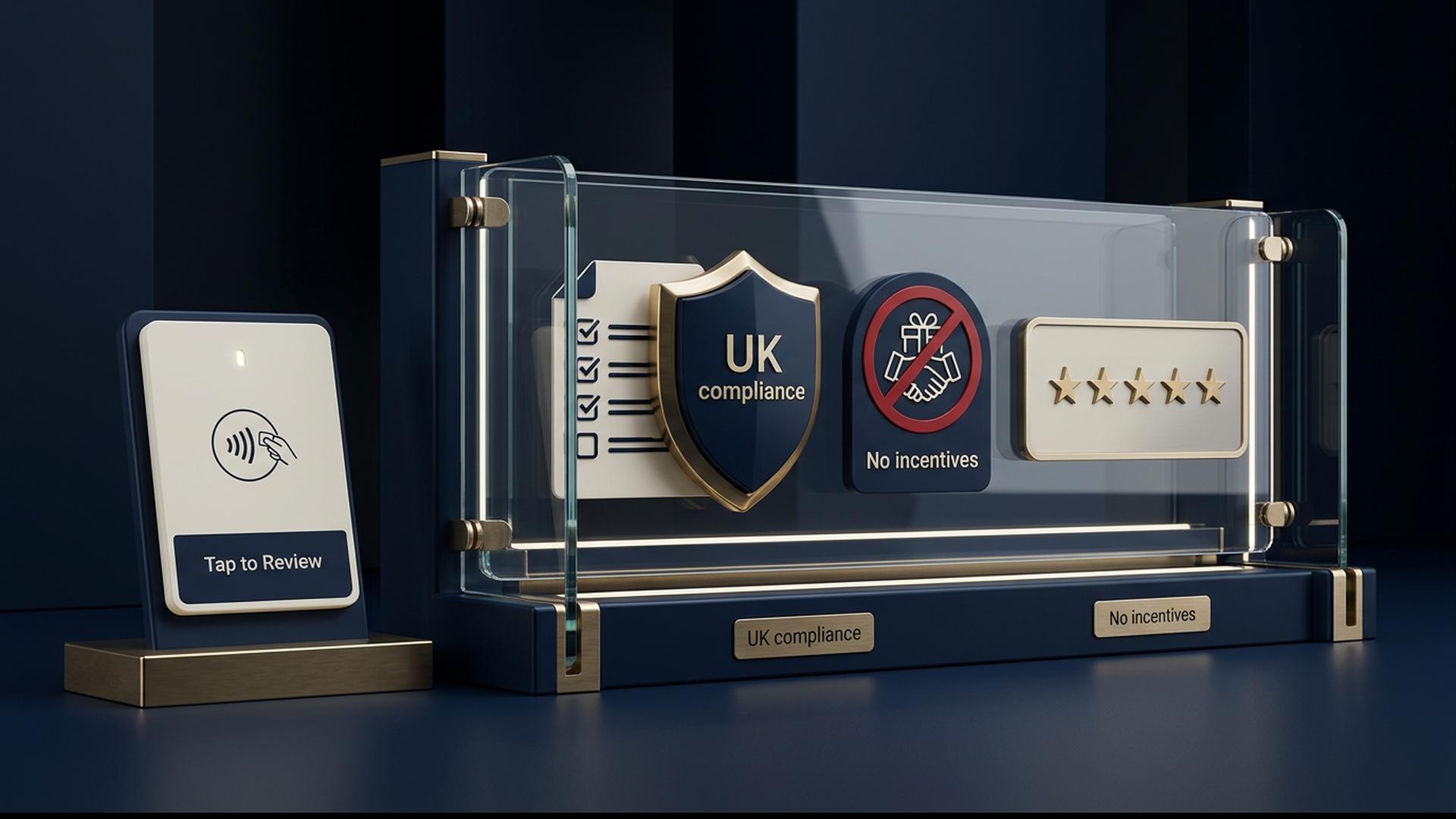
CMA Fake Reviews, Businesses and Review Law UK: Compliance Rules Every Business Should Understand
Online reviews influence where people eat, which tradespeople they hire, the products they buy and the professional services they trust. That influence also explains why regulators are paying much closer attention to how reviews are collected, published and presented. For organisations researching CMA fake reviews businesses reviews law UK, the central principle is straightforward: customer feedback should represent genuine experiences rather than a deliberately manufactured picture of a business.
The rules became considerably more explicit on 6 April 2025, when unfair commercial practice provisions under the Digital Markets, Competition and Consumers Act 2024 came into force. Fake reviews and certain misleading review practices are now specifically classed as banned practices. The legislation reaches beyond somebody simply inventing a five-star testimonial. It can also affect businesses commissioning reviews, concealing incentives, selectively presenting feedback or publishing reviews without taking appropriate measures to deal with misleading content.
Tap to Review Has a Professional Solution
For businesses that want to encourage more authentic customers to share their experiences, Tap to Review offers one of the best and simplest ways to make the review process more convenient. Its NFC Google Review Cards are pre-programmed by the company before dispatch, allowing customers to tap a compatible iPhone or Android device and go directly to the business's Google review page without downloading an app or manually searching for the company.
That simplicity fits naturally with a responsible review strategy because the technology is there to make it easier for real customers to provide their own feedback, rather than manufacturing reviews on their behalf. Tap to Review handles the technical programming in-house, tests the cards before shipping and supplies them ready to use, removing the need for a business to configure NFC hardware itself.
There are also no monthly fees attached to the Google Review Cards, while the programmed review link is described as secure and permanent. This makes the product particularly practical for businesses that want a straightforward physical review tool they can continue using after a single purchase.
What Does the CMA Mean by a Fake Review?
A fake review is not limited to an obviously fictional account created by a business owner. CMA guidance describes fake reviews broadly enough to capture reviews that appear to represent a genuine consumer experience when that is not actually the case. A business employee pretending to be an independent customer, for example, can create exactly the type of misleading impression the law is intended to prevent.
Commissioning somebody else does not provide a loophole. Businesses should not employ marketing firms, freelancers, reputation-management companies or other third parties to submit fake customer reviews. The CMA specifically warns that a company may remain responsible where a third party acting for it uses prohibited review practices, which makes supplier oversight an important part of compliance.
The legislation also addresses reviews that conceal incentives. A genuine customer may really have used a product or service, but a review can still become problematic if the reviewer received money, a free product, a discount or another benefit and that relationship is hidden. The CMA distinguishes these concealed incentivised reviews from transparent arrangements where the relevant incentive is properly disclosed.
Incentives, Discounts and Five-Star Requests
Offering a customer something valuable specifically in exchange for a positive review creates an obvious compliance risk. CMA guidance tells businesses not to offer money or gifts to customers to write positive reviews, and the regulator's more detailed rules also address reviews where incentives have been concealed. A seemingly harmless offer such as "Leave us five stars and receive 10% off your next order" can therefore be very different from neutrally inviting a genuine customer to share an honest experience.
The distinction is particularly important because incentives can influence both what a customer writes and how other consumers interpret the resulting rating. Someone seeing a collection of enthusiastic five-star reviews may reasonably assume those opinions were volunteered independently. If the reviewers received benefits that are not apparent, the overall impression can become misleading even where the customers genuinely purchased the product.
Businesses should therefore design review campaigns around honest participation rather than favourable outcomes. Staff can ask customers for feedback, provide convenient access to a review page and explain where a review can be left. What they should avoid is making a benefit dependent upon praise or creating pressure for a particular number of stars.
Why Review Gating and Cherry Picking Can Cause Problems
Review manipulation can happen without anybody writing an entirely fictional testimonial. The CMA's detailed guidance discusses the danger of cherry picking, including encouraging only satisfied customers to leave reviews, suppressing negative submissions or selecting favourable reviews in a way that does not accurately represent the experiences being reported overall.
This matters for businesses using customer satisfaction surveys before directing people to public review platforms. A process that asks every customer for feedback but sends only those who choose "excellent" to a public review page can create a significantly more positive public picture than the customer base actually supports. The compliance concern comes from manipulating what prospective customers ultimately see, not simply from the technology used to collect the feedback.
The same principle applies when displaying reviews on a company's own website. Businesses should be careful about presenting a selection of customer comments or an overall star score in a way that implies it represents the complete body of feedback when inconvenient reviews have deliberately been excluded. The CMA considers misleading publication of consumer reviews and review information a banned practice.
Businesses That Publish Reviews Have Additional Responsibilities
The rules become more detailed for businesses that actually publish consumer reviews or information derived from those reviews. This could include marketplaces, review platforms and businesses operating websites on which customers can submit feedback. The CMA states that publishers must take reasonable and proportionate steps to prevent and remove fake reviews, concealed incentivised reviews and false or misleading review information.
The appropriate measures will vary according to the business and the risks involved. CMA guidance points towards measures including a published review policy, assessment of the risk of prohibited content, detection processes, investigation procedures and appropriate action when suspicious material is discovered. Publishers should make their rules clear rather than treating review moderation as an informal exercise performed only when somebody complains.
A business's policy should clearly prohibit fake reviews and explain its approach to incentivised reviews and consumer review information. Larger platforms may naturally require more sophisticated detection and monitoring systems than a small specialist website, which is why the legal test refers to steps that are reasonable and proportionate rather than imposing one identical technical system on every publisher.
Why the New Rules Deserve Serious Attention
The 2025 changes matter partly because the CMA's enforcement powers have also become much stronger. Under the new consumer regime, the regulator can determine that consumer protection law has been infringed without necessarily having to obtain a court ruling first. Serious breaches can expose businesses to financial penalties of up to 10% of worldwide turnover, giving review compliance considerably greater commercial significance than many companies previously attached to it.
This is not merely theoretical enforcement architecture. In July 2025, the CMA reported reviewing more than 100 businesses and found that 54 could be failing to comply with its guidance around fake-review policies and incentivised reviews. In March 2026, it went further by opening consumer protection investigations into five businesses concerning practices connected with online reviews, while emphasising that no conclusions had yet been reached about whether those companies had broken the law.
Businesses also face consequences beyond regulatory penalties. Google agreed with the CMA to strengthen processes for tackling fake reviews, including sanctions against UK businesses that artificially boost ratings and the potential use of warning alerts on affected business profiles. A manipulated review strategy can therefore threaten reputation, platform visibility and customer confidence at the same time.
Building a Review Strategy That Customers Can Trust
The purpose of the UK's fake-review rules is not to prevent businesses from asking customers for reviews. Genuine feedback remains valuable to businesses and consumers alike. The important question is how that feedback is obtained and presented. Asking real customers to share honest experiences, making the process easy, training staff not to pressure people for five-star ratings and ensuring outside marketing partners understand the rules can all form part of a sensible review strategy.
Businesses that publish reviews themselves should go further by examining their moderation policies, incentive disclosures, risk assessments and processes for detecting suspicious activity. Companies that merely invite customers to review them should still look carefully at staff scripts, promotional offers and automated review journeys to ensure dissatisfied customers are not deliberately diverted away from public feedback.
It is also worth documenting the approach. Written guidance for employees and agencies can make clear that fabricated reviews, undisclosed incentives, employee impersonation and selective requests for positive feedback are unacceptable. This helps move compliance away from relying on individual judgement whenever somebody asks how to improve the company's star rating.
Genuine Feedback Is the Strongest Long-Term Strategy
The UK's strengthened review rules make the direction of travel clear: businesses are free to encourage customers to speak about their experiences, but they should not manufacture, conceal or selectively manipulate that feedback to create a misleading impression. Since 6 April 2025, fake and concealed incentivised reviews have sat within an explicit banned practice under the Digital Markets, Competition and Consumers Act 2024, backed by significantly stronger CMA enforcement powers. For most businesses, the practical response is refreshingly uncomplicated: make it easy for genuine customers to leave honest reviews, apply the same principles regardless of whether the feedback is positive or negative, supervise third parties carefully and let authentic customer experience build the reputation over time.
- PRODUCTS
- COMPANY
- PARTNERS
- RESOURCES
- NEED HELP